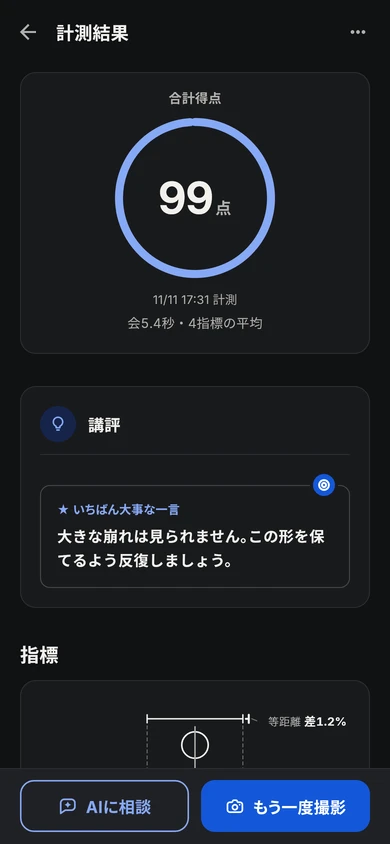
Just stand your phone up and shoot.
An app that scores kyudo (Japanese archery) shooting form on the spot. It detects kai (the full draw) automatically.
Video does not leave the device.
In development and field trials (before store release)
Records, scoring, consultation and messages, all in one app.
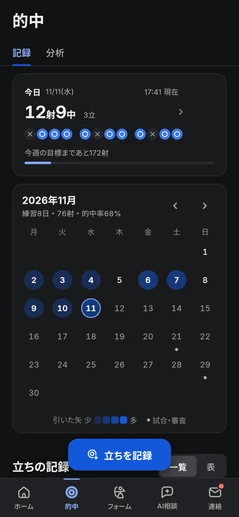
Hits
Records hits, misses and yadokoro (where each arrow lands) shot by shot, and automatically summarizes hit rate and tendencies.
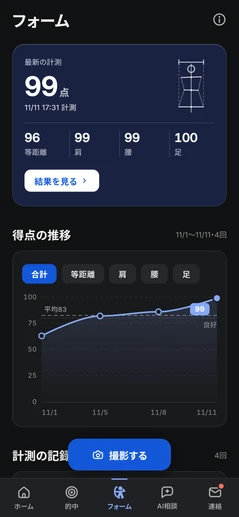
Form
Scores shooting form on four metrics. You can review it with delayed playback and the score trend.
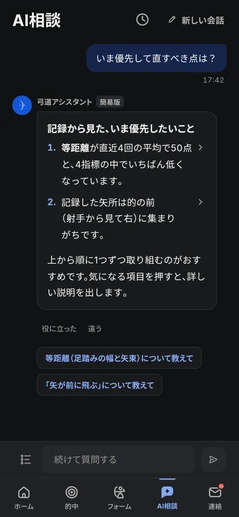
AI consultation
Answers questions about shooting technique and practice, based on your records. It normally answers on the device and does not use the network.
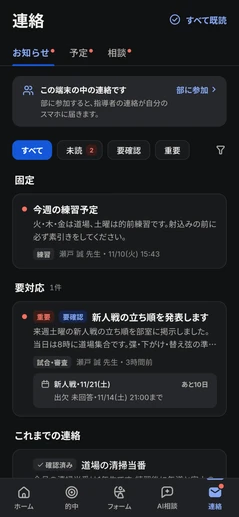
Messages
Brings together announcements, schedule and attendance, and consultation with instructors.
The screens show the app in development as of November 2026. The data shown is sample data, and all names are fictional.
Not enough time to teach, not enough trained eyes, not enough people to take on the role.
About 65,000 high school students practice kyudo (Japanese archery), the most among martial arts club activities. Instruction comes a few times a week, for a few minutes per person. With club advisors being transferred and club activities shifting to the community, instructors are moving away from schools.
Interest in the role of external instructor stands at 34%. The top reason for not taking it on is “not at a level to instruct / not confident,” at 58.1%.
Sources: All Japan High School Athletic Federation (fiscal year 2022); Tokyo Metropolitan Government survey on external instructors; Japan Research Institute report; Japan Sports Agency materials on “the transition of club activities to the community”
From filming to scoring, on the spot.
Set it up and film
Stand the phone upright in portrait orientation and place it 3–5 m directly in front of the archer, at chest height.
Automatic kai detection
When the archer enters kai, measurement starts automatically and the seconds until hanare (the release) are recorded.
Scoring and feedback
Sanju-jumonji (the three crosses: shoulders, hips, feet) and equidistance are scored out of 100, and the points to correct are shown.
Video does not leave the device.
Records and privacy
Records are stored on the device. Only when you join a club does the app send what the club needs for its messages and instruction to the club server.
- On the device only
- Recorded video, AI consultation conversations, and the notes for each round stay on the device only.
- When you join a club
- The app sends your name, school year, dan rank and role; round records (hits, misses and yadokoro) and the numerical values of form measurements; read and confirmation status for announcements; attendance for events and the note attached to it; the content of consultations and their read status; and the device type and app version. Records from before you joined are sent as well, and all of the club’s instructors can see them. Video and the notes for each round are not sent.
- Online AI
- It can be used only when someone who has joined a club and been approved turns on “Use online AI” in the settings and consents. The question, the exchange just before it and the numerical values of the records are sent to a generative AI through the club server. Names and video are not sent, and the club server keeps neither the questions nor the answers. Questions the app reads as reports of injury or pain are not sent online; they are answered on the device.
- Consultation with instructors
- The member and all of the instructors read it, so it is not a one-to-one exchange. No photos or video are attached; of the records, only the numerical values are attached.
For now, the club server is for development only.
From the skeleton to four metrics.
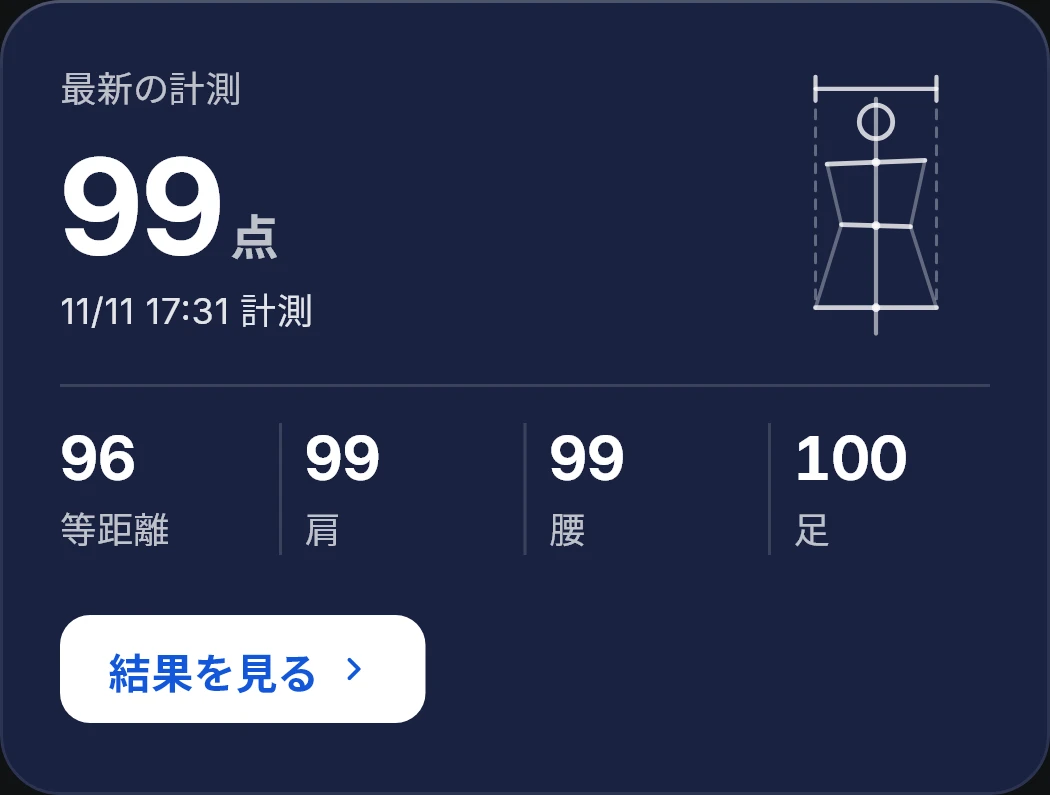
The skeleton is estimated on the device, and the posture throughout kai is scored as a whole. Four metrics are scored, equidistance and sanju-jumonji (shoulders, hips, feet), each out of 100. Lengths are expressed as ratios between distances and tilts as angles, so the design is not easily affected by resolution or filming distance. The seconds in kai, the mete elbow (the elbow of the drawing hand) and kuchiwari (the height of the drawing hand relative to the mouth) are shown as reference values and are not included in the score.
The score puts the shape seen in the image into numbers; how closely it matches an instructor’s evaluation has not yet been verified. The values used for judging and scoring are still to be calibrated, using video filmed while actually drawing a bow.
- Pose estimation
- ML Kit Pose Detection (runs on the device)
- AI consultation
- A basic on-device version (knowledge of 90 topics) and optional generative AI (in development)
- App
- Flutter (in development for Android)
- Club server
- Cloudflare Workers + D1 (for development)
From kyudo to form-based sports around the world.
- Second half of 2026
Field trials begin
- 2027
Store release
- 2028
Nationwide
- 2029 onward
Overseas and other sports
This is the plan as of now.